Category: Uncategorized

  • Are Custom Temporary Tattoos Safe? An Ingredient and Compliance Guide for Buyers

    Are Custom Temporary Tattoos Safe? An Ingredient and Compliance Guide for Buyers

    Temporary tattoos are one of the most popular event and promotional items there is, and for most people they are harmless fun. But the phrase covers products that range from genuinely low-risk to genuinely dangerous, and if you are buying them in bulk to hand out with your brand on them, you inherit some responsibility for what ends up on other people’s skin. This guide explains how temporary tattoos are regulated, where the real hazards are, and exactly what to require from a supplier before you place a custom order. It is general information rather than legal or medical advice, and regulations change, so treat it as a starting point for your own due diligence.

    How temporary tattoos are actually regulated

    In the United States, temporary tattoos are treated as cosmetics by the Food and Drug Administration, which means the color additives used in them are supposed to be ones the FDA has approved for that kind of use. Not every pigment that is legal in some product is legal for applying to skin, and the agency has noted that it has received reports of reactions even to ordinary decal-style tattoos. Being regulated as a cosmetic does not mean every product on the market is compliant, only that a standard exists to hold a supplier to. In the European Union the comparable framework is the Cosmetics Regulation together with REACH restrictions on specific substances, and where a product is sold as a toy for children, toy-safety standards such as the EN 71 series add further limits on what can migrate out of the material. Which rules apply to your order depends on the market you sell into and on how the product is marketed, so this is worth pinning down early rather than assuming.

    The real hazard is “black henna,” not the decals

    The serious injuries associated with temporary tattoos overwhelmingly involve so-called “black henna,” not printed decals. Natural henna produces a reddish-brown stain and works slowly; to make a darker, faster, blacker design, some operators add para-phenylenediamine, a coal-tar hair-dye chemical known as PPD. On skin, PPD can cause severe allergic contact dermatitis, blistering, and permanent scarring, and it can sensitize a person for life so that any future exposure to related chemicals triggers a reaction. Health authorities have documented these cases repeatedly, including in young children, and the FDA has been explicit that henna is not approved for direct application to the skin. This is the single most important safety fact in the category, and it is why the risk of a product depends far more on what it is than on the word “temporary.”

    The chart below places the common types on a relative-risk scale. The ranking is the reliable part; treat the exact numbers as indicative, because individual allergies vary and a person can react to almost anything.
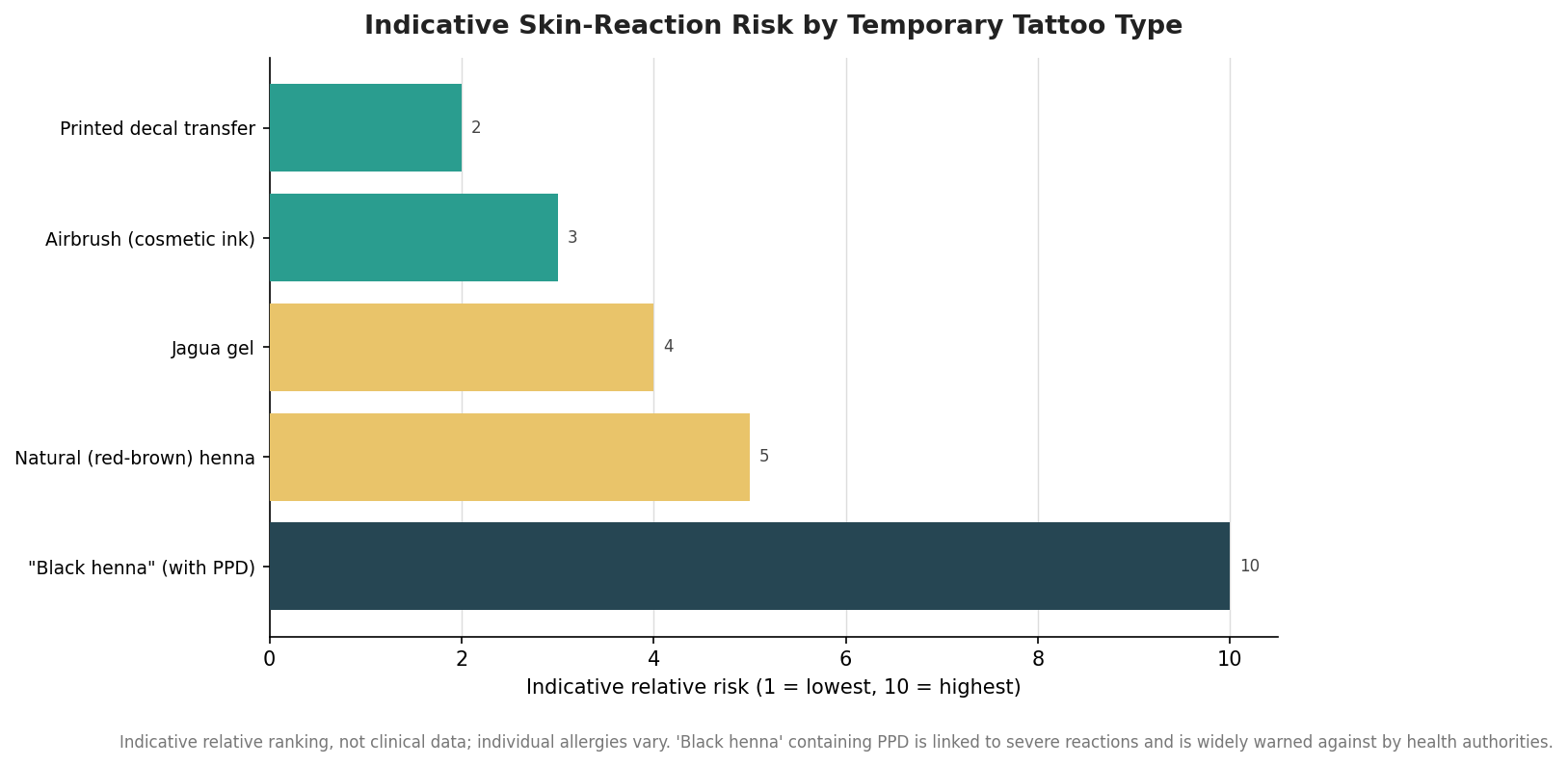
    Horizontal bar chart of indicative skin-reaction risk by temporary tattoo type, lowest for printed decal transfers and highest for black henna containing PPD
    The label ‘temporary tattoo’ covers products with very different risk profiles.

    The everyday-safe options for custom orders

    The good news is that the products most people actually order for events and promotions sit at the low-risk end. Printed decal transfers, the classic press-on-with-water tattoo, are typically made with cosmetic-grade colorants and a skin-safe adhesive, and they are the natural home for detailed, full-color, logo-accurate artwork. Airbrush tattoos use cosmetic inks over a stencil and are low-risk when the inks are formulated for skin, though they render fine detail less crisply. Jagua-based products, derived from a fruit, give a dark stain some buyers want as a henna alternative, and while generally lower-risk than PPD black henna, they are still a botanical extract that some people react to. The comparison below weighs the main custom-orderable methods on ingredient simplicity and how faithfully they reproduce a detailed design.
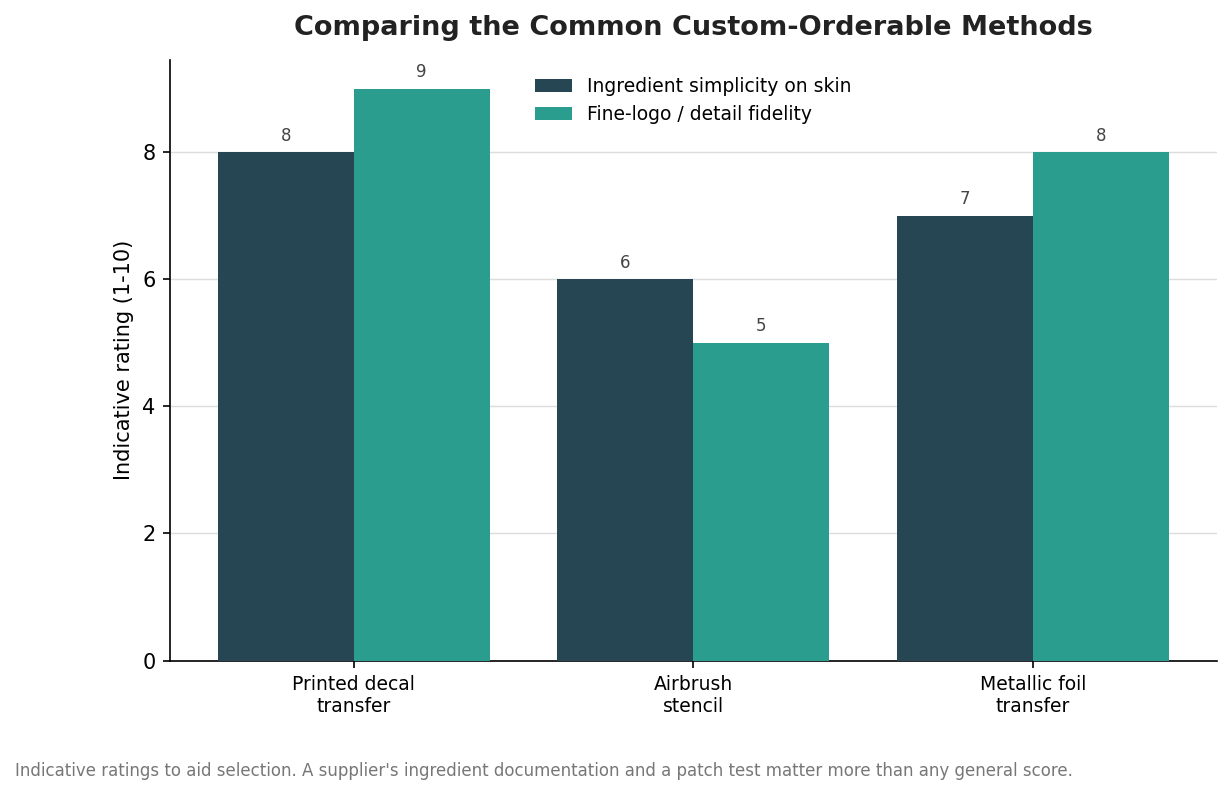
    Grouped bar chart comparing printed decal transfers, airbrush stencils, and metallic foil transfers on ingredient simplicity and fine-logo fidelity
    For custom-branded orders, the printed decal transfer usually balances safety and detail best.

    For a branded run where a recognizable logo has to look sharp, the printed decal transfer usually wins on both counts, which is why it dominates the promotional side of the market. The point is not that one method is universally best, but that the safe, effective options are well established and there is no reason to drift toward the risky end of the spectrum for a giveaway.

    What to require from a supplier before you order

    Put the safety burden where it belongs, on documentation, before money changes hands. Ask any supplier to confirm in writing that the colorants are approved cosmetic color additives for skin contact in your market, that the product is free of PPD and is not “black henna,” and that the adhesive is skin-safe. Request the ingredient list and any compliance or test documentation relevant to where you will distribute, and if the tattoos are aimed at children, ask specifically about the toy-safety standards that apply. A credible manufacturer will have this material ready; hesitation or vague reassurance is itself a useful signal. It is also worth confirming that the products carry appropriate use and warning information, since regulators expect temporary tattoos to be labeled like the cosmetics they are.

    A sensible final step

    Even with clean paperwork, recommend a patch test, especially for anything going on children or sensitive skin: apply one tattoo to a small area a day ahead and watch for redness or irritation before a whole event’s worth goes on. That single habit catches the rare individual sensitivity that no certificate can predict. Choose a reputable product type, insist on the documentation, keep well away from PPD-based “black henna,” and custom temporary tattoos are a safe, effective way to put your brand on the crowd. Cut corners on the sourcing and you are gambling with someone else’s skin, which is never a trade worth making for a promotional item. When in doubt about the rules for your specific market or use, confirm the current requirements with the relevant authority or a qualified advisor rather than relying on a general guide.
  • Temporary Tattoo Types Compared: Wear Time, How They Set, and Skin Safety

    Temporary Tattoo Types Compared: Wear Time, How They Set, and Skin Safety

    “Temporary tattoo” covers several very different things: a printed sheet you press on with water, an airbrushed stencil, and plant or gel stains like henna and jagua that color the skin itself. They wear for different lengths of time, they set on completely different schedules, and they are not equal on skin safety. Here is how the main types compare, and what the FDA actually says about the ingredients.

    Two families: color on the skin versus color in the skin

    The cleanest way to sort temporary tattoos is by where the color lives. Printed decals and airbrush tattoos sit a layer of pigment on top of the skin, held by an adhesive or a light body paint. Henna, jagua, and genipin-based semi-permanent inks work the opposite way: they deposit a dye that reacts with the outermost skin cells and stains them, so the design is in the skin rather than on it. That single difference drives almost everything else, including how fast the design appears, how long it lasts, and which safety rules apply.

    For a custom, branded design, the printed decal is the workhorse. It reproduces a logo or full-color artwork exactly, goes on in under a minute, and looks identical from the first person to the thousandth. Stain-based methods are prized for a hand-drawn, skin-toned look but are harder to reproduce precisely and take real time per person, which matters when you are decorating a line of guests at an event.

    How long each type lasts

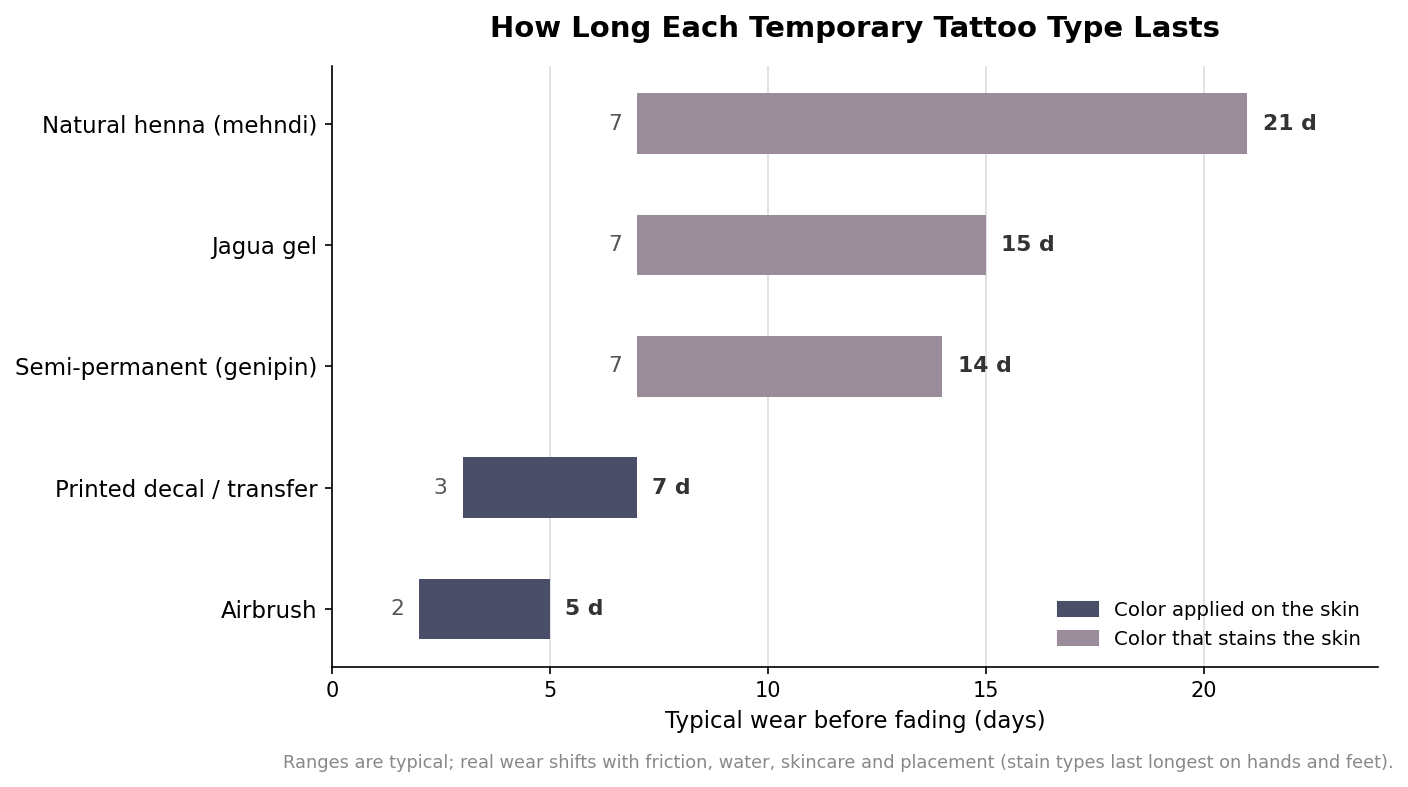
    Wear time separates the quick decorations from the semi-permanent stains. Airbrush designs typically last about two to five days, and printed decals about three to seven, because both sit on the surface and wear off as the outer skin sheds and rubs against clothing. The stain family lasts noticeably longer: genipin-based semi-permanent inks run roughly one to two weeks, jagua about seven to fifteen days, and natural henna anywhere from one to three weeks, with the deepest, longest-lasting color on thicker skin like the hands and feet. None of these are exact; friction, swimming, soaps, and skincare products all shorten the range.

    Range bars of typical wear time: airbrush 2 to 5 days, printed decal 3 to 7 days, semi-permanent genipin 7 to 14 days, jagua 7 to 15 days, natural henna 7 to 21 days
    Typical wear time by temporary tattoo type; surface color fades fastest, skin stains last longest.

    Match the wear window to the occasion. A one-day festival, a race, or a product launch is well served by a decal or airbrush design that fades on its own within a few days. A vacation, a wedding week, or anyone who wants the look to ride out several showers leans toward jagua or henna. If you want a custom logo that reads perfectly and disappears fast, the printed decal is usually the better fit; if you want an organic, evolving stain and can wait for it, the plant and gel options earn their longer wear.

    Instant color versus a slow-developing stain

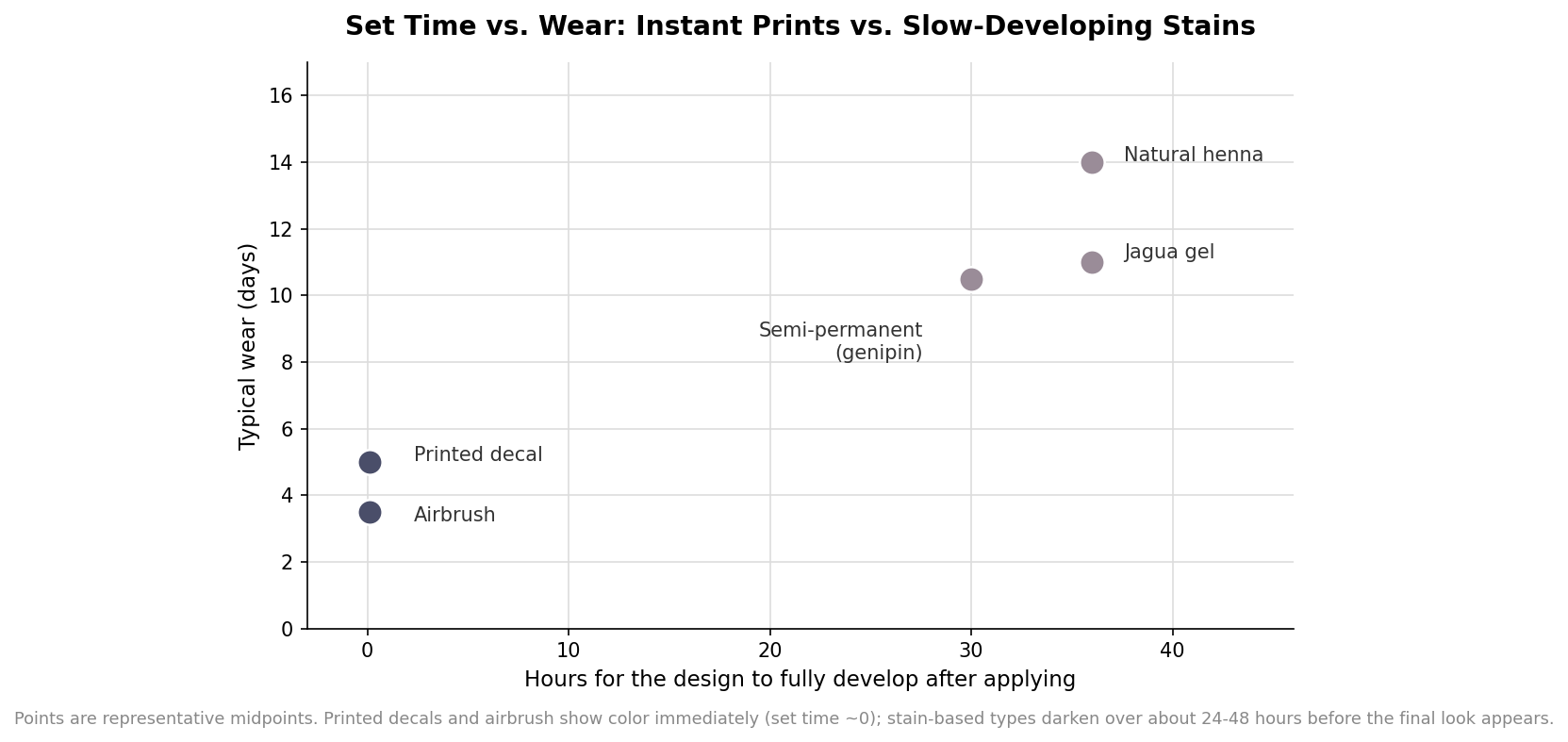
    The other schedule that trips people up is set time. Printed decals and airbrush tattoos show their final color the instant they go on, because the pigment is already visible. Stains are the opposite: jagua and henna go on as a paste or gel that looks faint at first and then darkens over roughly 24 to 48 hours as the dye oxidizes, and genipin inks develop on a similar one-to-two-day curve. Jagua in particular needs to stay dry for the first couple of hours and ideally avoids soap for the first day so the stain can mature.

    Scatter plot of set time versus wear: printed decal and airbrush develop instantly, while genipin, jagua and henna take about 24 to 48 hours to reach full color
    Set time against wear time: printed decals and airbrush show color at once, while stain-based types darken over one to two days.

    Plan around the develop time, not just the event date. If guests need to look finished the moment they walk away, a slow-developing stain applied on-site will still be pale when they leave; it only reaches full depth a day or two later. That is a strong argument for printed decals at same-day events and a reason to apply henna or jagua well before the moment you want it to peak.

    What the FDA actually regulates

    In the United States, both decal temporary tattoos and henna are regulated by the FDA as cosmetics, and the agency’s core rule is about color additives. The FDA states that all color additives used in cosmetics must be approved for their intended uses. That framing matters for henna: the FDA says henna “is approved only for use as a hair dye” and “is not approved for direct application to the skin, as in the body-decorating process known as mehndi,” which technically makes skin application an unapproved use. Plenty of natural henna is applied anyway by experienced artists, but the regulatory status is worth knowing.

    The real hazard the FDA warns about is “black henna.” To darken henna and speed it up, some products add a coal-tar hair dye containing p-phenylenediamine, or PPD, which the FDA says “can cause dangerous skin reactions in some people.” The agency is blunt that, by law, PPD “is not permitted in cosmetics intended to be applied to the skin,” and it has documented blistering and long-lasting allergic reactions traced to black henna. The practical takeaway is simple: avoid any “black henna” or unusually fast, jet-black stain, and treat a temporary tattoo the way you would a new cosmetic by patch-testing on a small area a day or two ahead if you have sensitive skin. Reputable printed-decal tattoos are made with color additives approved for that cosmetic use and a skin-contact adhesive, which is part of why they are a predictable choice for large branded runs, though you should still confirm a supplier’s compliance and skin-safety information rather than assume it.

    Choosing the right type for the job

    Work backward from three questions: how exact the design must be, how long you want it, and how much time you have per person. For a logo, a mascot, or full-color artwork that has to look the same on everyone and go on fast, a printed decal wins on precision and speed. For a short, playful, one-day look with a painted finish, airbrush is a good fit. For a hand-drawn, skin-toned aesthetic that lasts a week or more, henna and jagua deliver, provided you build in the develop time and, for henna, accept the regulatory gray area and choose a trusted artist who uses plain, natural paste.

    Sort by where the color lives, match the wear window and the set time to your event, and keep the black-henna warning in mind, and the “temporary tattoo” you order will behave the way you expect rather than surprising you a day later.

  • Custom Temporary Tattoos for Events: How to Match the Type to the Occasion

    Custom Temporary Tattoos for Events: How to Match the Type to the Occasion

    The temporary tattoo that shines at a music festival is rarely the one you want on a corporate trade show floor, and the version a bride hands out at her welcome party has almost nothing in common with the design a school orders for field day. They are all “custom temporary tattoos,” but the finish, the size, the wear time, and the order minimum pull in different directions depending on the occasion. Choosing well starts with the event, not the artwork.

    This guide walks through the main use cases and the type of tattoo that actually fits each one, so the sheet you order looks the way you pictured it and lasts exactly as long as you need.

    Start with how long it needs to last

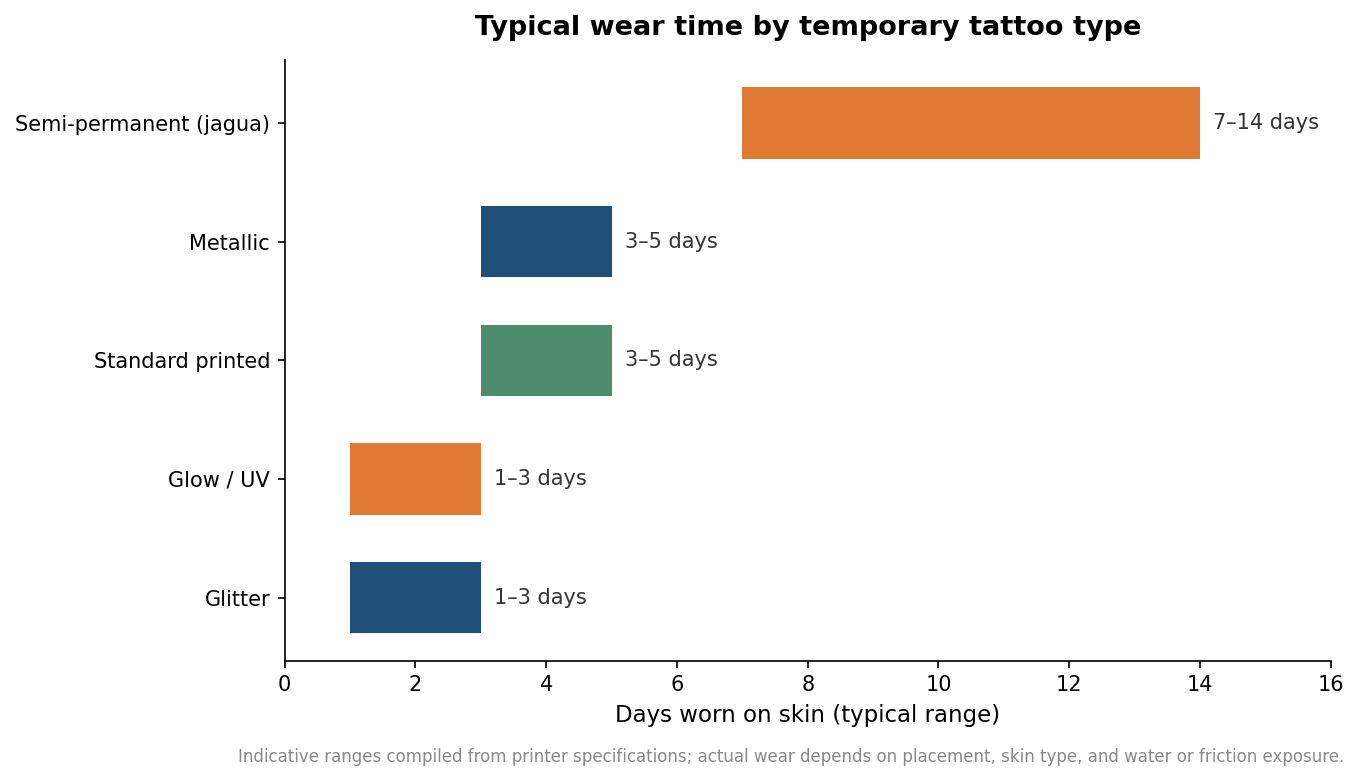
    Wear time is the first filter, not the design. A standard printed temporary tattoo applied to clean, dry skin typically holds for three to five days with normal washing, though high-friction spots like the inside of the wrist or the side of a finger give out sooner. Glitter and glow or UV finishes tend to be a one-to-a-few-day proposition: they photograph beautifully under lights but are not built for a work week. At the other end, semi-permanent styles that use a jagua-based ink stain the top layer of skin and can last up to about two weeks. If your event is a single evening, longevity barely matters and you can chase the most eye-catching finish. If you need the design to survive a three-day conference or a wedding weekend, that decision narrows your options considerably.

    Horizontal bar chart of typical wear time in days for glitter, glow, standard, metallic, and semi-permanent temporary tattoos
    Standard printed tattoos hold three to five days; semi-permanent jagua styles can last up to two weeks.

    Weddings, showers, and milestone parties

    Metallic tattoos in gold and rose gold are the workhorse here. The “flash tattoo” look reads as jewelry from a few feet away, sits well on wrists, forearms, and shoulders, and the three-to-five-day wear window comfortably covers a Friday-to-Sunday celebration. Keep individual designs small, in the neighborhood of two inches, so they layer like bracelets rather than dominating the arm. One planning note that catches people off guard: the minimum order at Customized Temporary Tattoos is 12, including metallic foil, so even a small wedding can order a finish like this. Order the design once, in a size that flatters, and hand out generously.

    Festivals, concerts, and night events

    This is the one context where glitter and glow or UV finishes earn their keep. Stage lighting and blacklight make them pop in a way standard ink cannot match, and because most festival tattoos only need to survive one night, the shorter wear time is a non-issue. You also have more room to go large, since bold, high-contrast art holds up at a distance and in photos. Simple, chunky designs beat fine linework under these conditions; thin details tend to disappear once the crowd, the sweat, and the low light get involved.

    Trade shows, brand activations, and giveaways

    Full-color logo tattoos in a standard finish are the marketing default. A two-inch-by-two-inch square is a sensible baseline that renders a logo cleanly without asking too much of anyone’s forearm. The minimum order at Customized Temporary Tattoos is 12, and the cost per tattoo moves with size, color count, finish and quantity, so the quote form is the quickest way to see where your order lands. Build in lead time: standard turnaround is about 2 weeks after artwork is approved, and the approval step itself matters. Always request a printed or digital proof and check that small text and thin lines survived the conversion, because a logo that looks crisp on screen can turn muddy at tattoo scale.

    Kids’ parties, schools, and sports days

    For anything involving children, skin safety and easy removal outrank everything else. Reputable temporary tattoos are made from skin-safe, non-toxic materials, but a patch test on a small area is still worth doing for sensitive skin, especially in a group setting where you cannot check every child’s history. Keep the designs small and the application simple: press the tattoo face-down onto clean skin, hold a damp cloth against the backing for about thirty seconds, and peel the paper away. Standard finishes are the right call here, both for cost and because removal with a little baby oil or rubbing alcohol is painless when the party is over. For sports days and 5K events, the same standard finish works at a larger size for team numbers, mascots, or spirit marks that only need to last the day.

    When you want it to stick around

    Semi-permanent tattoos occupy their own category. Because the jagua-based formula stains rather than sits on top of the skin, the design develops over a day and then lasts up to roughly two weeks, which makes it the natural choice for someone “test driving” a real tattoo placement or for a longer campaign where you want the mark to persist past a single event. The trade-off is that you cannot wipe it off early, so it suits committed uses rather than one-night novelties.

    Before you order

    Whatever the occasion, three habits prevent the most common disappointments. Size the art for the body part it will live on rather than the screen you designed it on, since two inches on a monitor and two inches on a wrist feel very different. Supply high-resolution artwork with clean edges, because temporary tattoo printing is unforgiving of soft or low-contrast files and is a frequent reason designs come out looking faded. And confirm the wear time and quantity for the specific finish you have chosen before you commit, so the metallic set you love arrives in the count you planned. Match the type to the moment, and the rest of the decision gets much easier.

  • How to Remove Temporary Tattoos: Fast, Safe Methods for Kids and Adults

    How to Remove Temporary Tattoos: Fast, Safe Methods for Kids and Adults

    A temporary tattoo comes off in a couple of minutes with things already in your bathroom cabinet. The trick is matching the method to your skin and to where the design sits, because the same rubbing alcohol that lifts a decal off a forearm in seconds is the wrong choice for a child’s cheek. This guide covers how long these tattoos last on their own, the fastest safe ways to remove one, the gentlest approach for kids, what to avoid, and how to apply one so it lasts exactly as long as you want.

    How long a temporary tattoo lasts before you need to remove it

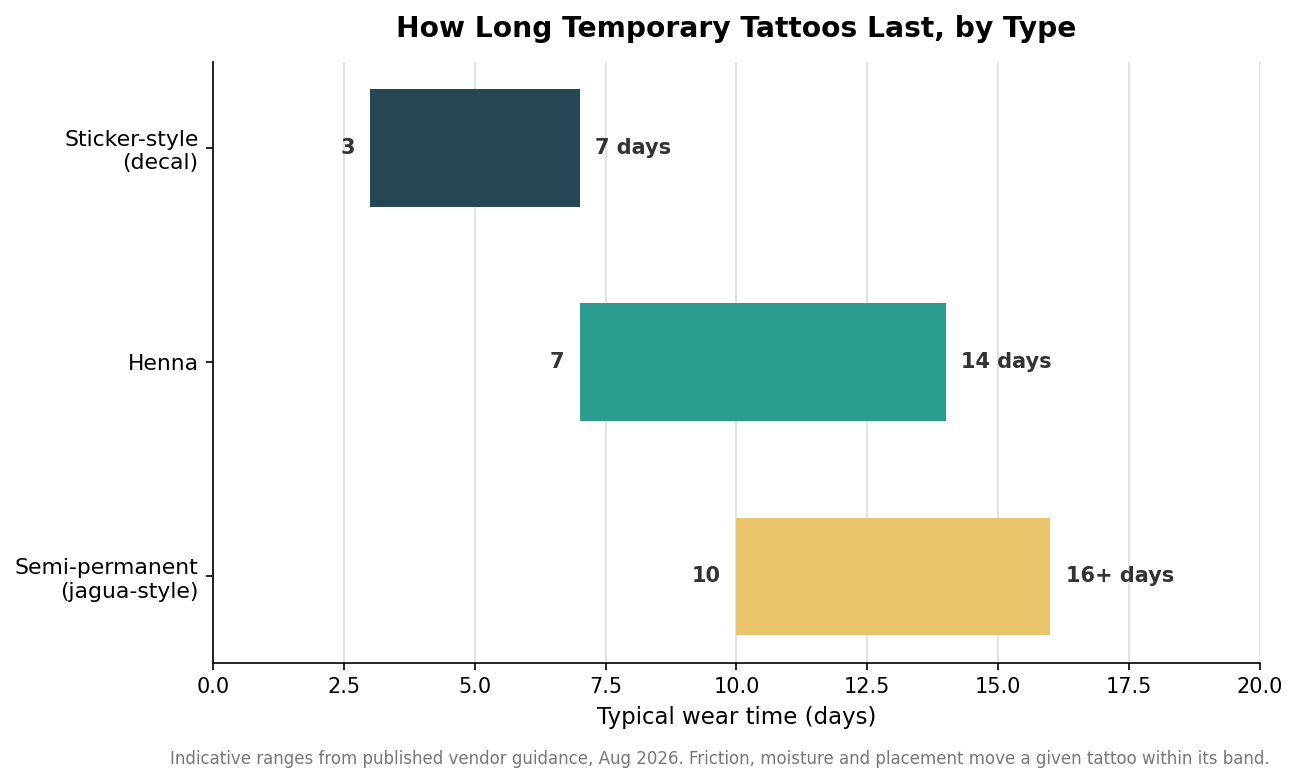
    Most of the removal questions people ask come down to impatience with a design that has started to crack and fade unevenly. A standard sticker-style decal typically lasts 3 to 7 days. Henna stains the skin rather than sitting on top, so it runs longer at roughly 1 to 2 weeks, and semi-permanent, jagua-based designs can hold 10 to 14 days or more. Those are ranges, not promises, because where you put the tattoo matters as much as the type. Friction from clothing, frequent washing, sweat, and naturally oily skin all shorten the life of a design, while a low-friction spot like the outer forearm, dry skin, and minimal water exposure extend it. If a tattoo already looks patchy after two or three days, that is usually placement and moisture at work rather than a defective product.

    Range chart of how many days temporary tattoos last by type: sticker, henna, and semi-permanent
    Sticker-style decals last about 3 to 7 days; henna and semi-permanent designs run longer.

    The fastest safe ways to remove one at home

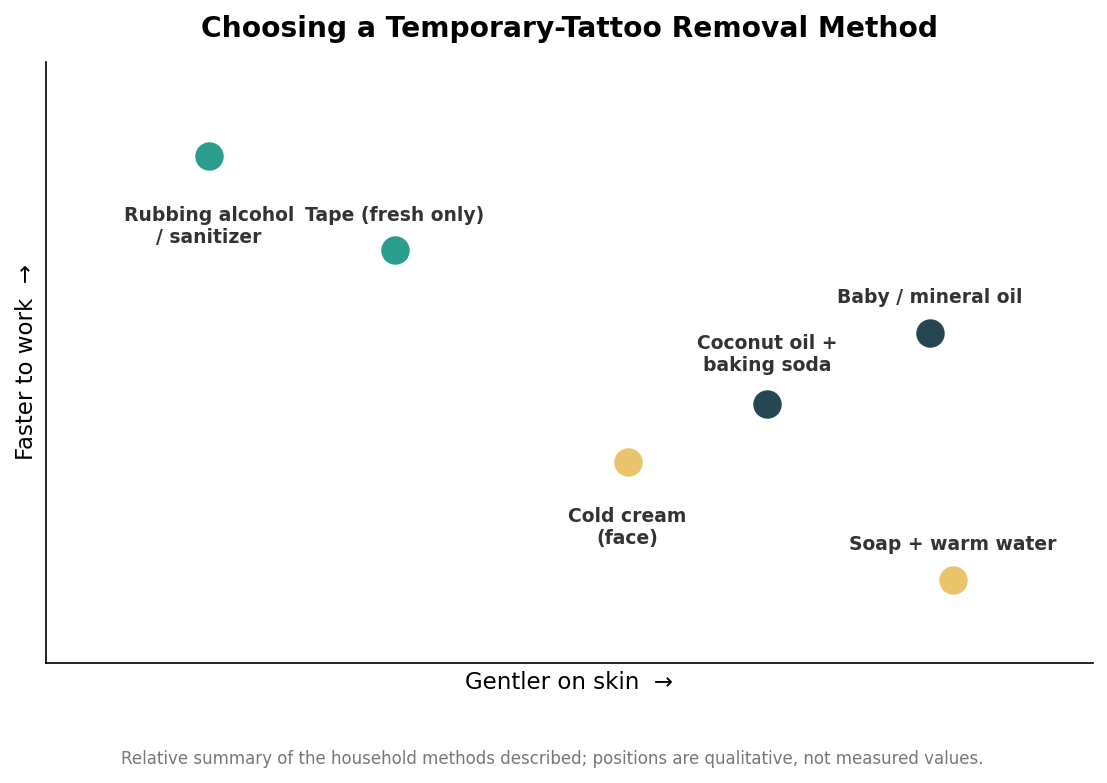
    The most reliable remover is oil. Baby oil or plain mineral oil dissolves the adhesive without irritating skin: soak a cotton pad, press it on the design for about 30 seconds, then rub in gentle circles and rinse. It is the go-to because it works on nearly everyone and rarely stings. When you want speed over gentleness, rubbing alcohol or an alcohol-based hand sanitizer breaks down the adhesive and lifts the pigment in 10 to 15 seconds, but it is drying and best kept for occasional use on tougher skin rather than daily removal.

    A few alternatives cover the situations oil and alcohol do not. A piece of adhesive tape pressed firmly and peeled away lifts a fresh, lightly set design before it has fully bonded, which is handy the moment you dislike a placement. A paste of coconut oil and baking soda mixed in equal parts works as a mild exfoliating scrub, applied for about a minute, that lifts pigment while leaving skin soft. Cold cream and other oil-based removers dissolve the adhesive while moisturizing, which makes them the better pick for delicate areas. And plain warm water with soap, worked gently for a minute, is often enough on its own for a design that is already on its way out.

    Scatter chart positioning temporary tattoo removal methods by gentleness and speed
    Oil is the gentlest all-purpose remover; alcohol is fastest but drying and best used sparingly.

    Removing tattoos from kids and delicate skin

    For children, gentleness beats speed every time. Baby oil or coconut oil is the safest choice, because it lifts the design without the sting or drying that alcohol brings, and it doubles as a bit of a game while the oil sits and does the work. Keep alcohol, hand sanitizer, and vigorous scrubbing away from young skin and away from anyone’s face, where the skin is thinner and reacts more. If a design does not release on the first pass, reapply oil and wait rather than rubbing harder; patience removes far more than pressure does. The same rule applies to sensitive or easily irritated skin at any age: choose an oil, give it time, and stop if the skin starts to look pink or feel sore.

    What not to use, and how to care for skin afterward

    Some quick fixes cause more harm than the tattoo. Skip nail polish remover and pure acetone, which strip and dry the skin aggressively, along with rough exfoliants like coarse scrubs or abrasive pads, and undiluted essential oils, which can trigger irritation or an allergic reaction. None of these remove a temporary tattoo meaningfully faster than oil, so the trade is all downside. After the design is gone, rinse, pat dry, and apply a fragrance-free moisturizer, and give the area a day off from exfoliating, shaving, and direct sun so freshly rubbed skin can settle. If you ever see a rash, swelling, or lasting redness, treat it as a reaction, stop, and let a doctor take a look rather than reapplying anything to the spot.

    Applying and caring so it lasts exactly as long as you want

    Removal is easy; getting a clean, long-lasting application is where most of the disappointment actually starts. Prep the skin first by lightly exfoliating, washing, and drying the area completely, with no lotion or oil left behind, since anything on the surface stops the design from bonding. To apply, peel off the clear top film, press the tattoo face-down onto the skin, hold a damp cloth firmly over it for about 30 seconds until the paper backing slides away, then let it air-dry without touching it. A light dusting of baby powder once it dries helps set the ink and cuts the shine so the design reads as more skin-like.

    After that, the same factors that shorten a tattoo become your tools for extending it. Choose a low-friction spot, avoid tight clothing over the design, keep water and sweat exposure down, and pat rather than scrub after showering. Done well, these steps add several days to a decal that would otherwise fade fast. And when you are ready for it to go, you already know the two-minute oil routine to take it off cleanly.

  • Why Custom Temporary Tattoos Look Washed Out

    This is the most common complaint about custom temporary tattoos and it has exactly one cause, which is fixable at the quoting stage for very little money.

    What is actually happening

    The inks used in transfer tattoos are translucent by design, so the tattoo does not sit on skin like a sticker.

    That means whatever is underneath shows through. On skin, that is skin tone, and it shifts every color towards it.

    Why it looks fine in the proof

    Proofs are printed on white paper. White is exactly the background the ink needs, so the colors look correct.

    The moment the same film goes onto skin, the background changes and so does every color in the design.

    The fix

    A printed white layer beneath the color. The ink then sits on white rather than on skin, and reads as the approved color on every skin tone.

    It costs a little more per sheet and makes the film edge very slightly more visible. That is the whole trade.

    When you can skip it

    A single-color black design, which reads on most skin without help. Or a metallic foil, which is opaque already.

    For everything in full color going to a general audience, print the underlay.

  • The Complete Buyer’s Guide to Custom Temporary Tattoos

    Temporary tattoos look like the easiest thing to order in promotional print. Four decisions separate a run that works from a run that looks washed out.

    Ask for a white underlay

    Tattoo inks are translucent. Without a printed white layer beneath them the color blends with the skin it is on.

    The result is a design that reads on pale skin and disappears on dark skin. If the audience is the public, the underlay is not optional.

    Design for a surface that creases

    Large solid blocks of color crack wherever skin folds. Line art and small shapes move with it.

    Placement matters more than print quality: forearms and shoulders last for days, knuckles and wrists do not.

    Pick the finish from the venue, not the mood board

    Metallic foil is a real metal layer, so it flashes in sunlight and cracks across a hard fold. Keep it to lines and bands on flat skin.

    Glow charges under any light and glows in the dark. UV does nothing in the dark and only shows under a blacklight. Buying the wrong one wastes the whole run.

    Get the sheet kiss-cut for how you hand it out

    A kiss cut goes through the transfer and stops at the backing, so one design lifts and the sheet stays intact.

    Layouts that maximise designs per sheet are a false economy on a busy stand. Fewer, well-spaced designs move faster.

    What to send when you ask for a quote

    Artwork, quantity, where the tattoos will be handed out, and what the venue lighting is. The last two decide the finish and the cut before anything else.

  • Glow or UV?

    These two get used interchangeably in quotes and catalogues, and they behave completely differently. Ordering the wrong one wastes an entire run.

    Glow in the dark

    A phosphorescent pigment absorbs light and releases it slowly, so the design glows in a dark room after being charged under any light source.

    It is pale but visible in daylight, and the glow fades over time as it discharges, recharging whenever the lights come back on.

    UV reactive

    A fluorescent pigment that does nothing on its own. In daylight it is nearly invisible; under a blacklight it lights up brilliantly.

    In a dark room with no UV source, a UV tattoo does absolutely nothing at all.

    How to choose in ten seconds

    Does the venue have blacklights? Buy UV. Does it not? Buy glow.

    That really is the whole decision, and it is worth checking with the venue rather than assuming, because a marquee with festoon lighting and a club with UV bars need opposite products.

    A note on expectations

    Neither is as bright as the product photography suggests, because photographs of glowing things are always long exposures.

    Both are genuinely effective in the right room. Ask for a sample and look at it in the actual venue lighting if the order is large.