Temporary tattoos are one of the most popular event and promotional items there is, and for most people they are harmless fun. But the phrase covers products that range from genuinely low-risk to genuinely dangerous, and if you are buying them in bulk to hand out with your brand on them, you inherit some responsibility for what ends up on other people’s skin. This guide explains how temporary tattoos are regulated, where the real hazards are, and exactly what to require from a supplier before you place a custom order. It is general information rather than legal or medical advice, and regulations change, so treat it as a starting point for your own due diligence.
How temporary tattoos are actually regulated
In the United States, temporary tattoos are treated as cosmetics by the Food and Drug Administration, which means the color additives used in them are supposed to be ones the FDA has approved for that kind of use. Not every pigment that is legal in some product is legal for applying to skin, and the agency has noted that it has received reports of reactions even to ordinary decal-style tattoos. Being regulated as a cosmetic does not mean every product on the market is compliant, only that a standard exists to hold a supplier to. In the European Union the comparable framework is the Cosmetics Regulation together with REACH restrictions on specific substances, and where a product is sold as a toy for children, toy-safety standards such as the EN 71 series add further limits on what can migrate out of the material. Which rules apply to your order depends on the market you sell into and on how the product is marketed, so this is worth pinning down early rather than assuming.
The real hazard is “black henna,” not the decals
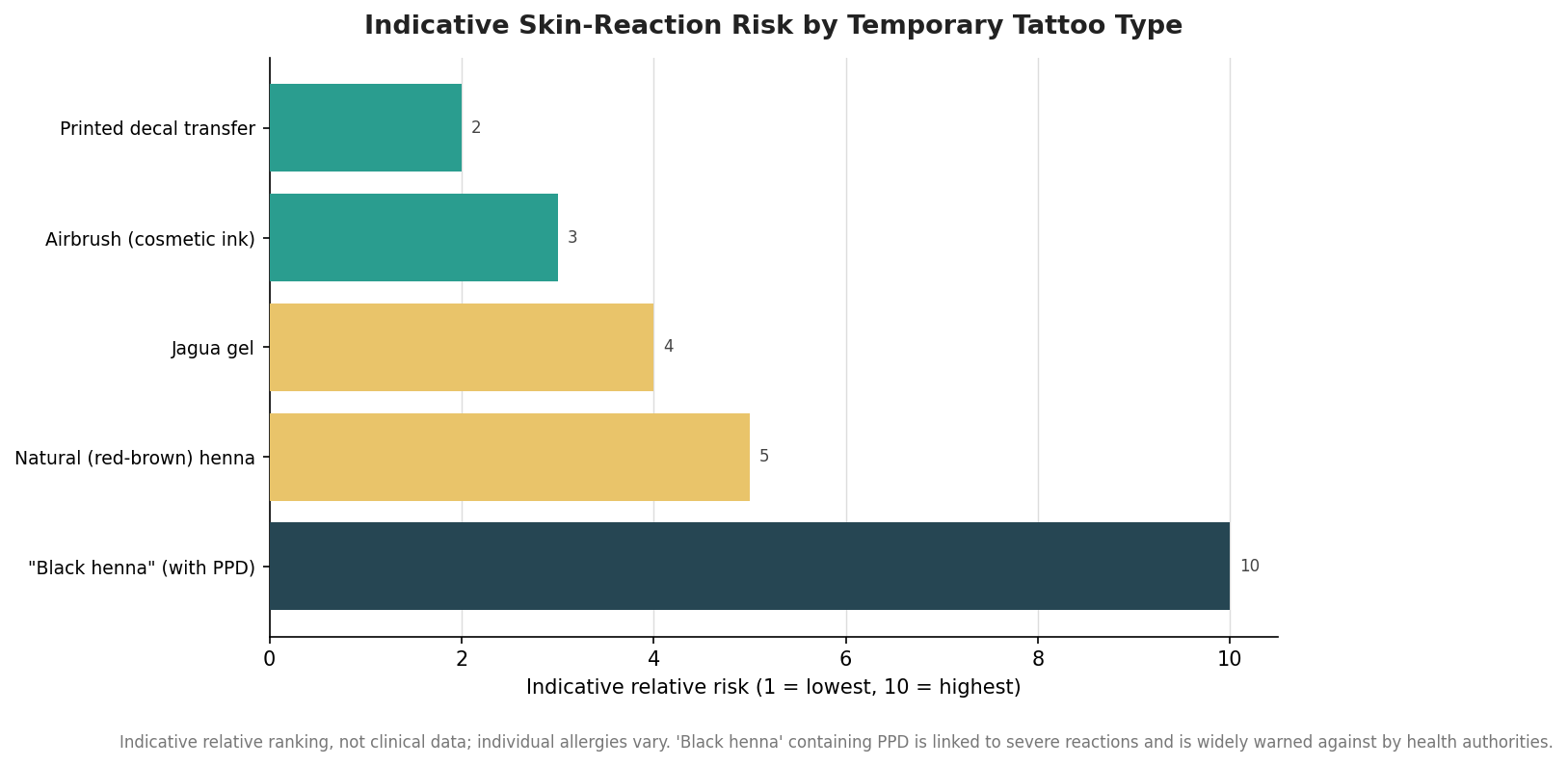
The serious injuries associated with temporary tattoos overwhelmingly involve so-called “black henna,” not printed decals. Natural henna produces a reddish-brown stain and works slowly; to make a darker, faster, blacker design, some operators add para-phenylenediamine, a coal-tar hair-dye chemical known as PPD. On skin, PPD can cause severe allergic contact dermatitis, blistering, and permanent scarring, and it can sensitize a person for life so that any future exposure to related chemicals triggers a reaction. Health authorities have documented these cases repeatedly, including in young children, and the FDA has been explicit that henna is not approved for direct application to the skin. This is the single most important safety fact in the category, and it is why the risk of a product depends far more on what it is than on the word “temporary.”
The chart below places the common types on a relative-risk scale. The ranking is the reliable part; treat the exact numbers as indicative, because individual allergies vary and a person can react to almost anything.
The everyday-safe options for custom orders
The good news is that the products most people actually order for events and promotions sit at the low-risk end. Printed decal transfers, the classic press-on-with-water tattoo, are typically made with cosmetic-grade colorants and a skin-safe adhesive, and they are the natural home for detailed, full-color, logo-accurate artwork. Airbrush tattoos use cosmetic inks over a stencil and are low-risk when the inks are formulated for skin, though they render fine detail less crisply. Jagua-based products, derived from a fruit, give a dark stain some buyers want as a henna alternative, and while generally lower-risk than PPD black henna, they are still a botanical extract that some people react to. The comparison below weighs the main custom-orderable methods on ingredient simplicity and how faithfully they reproduce a detailed design.
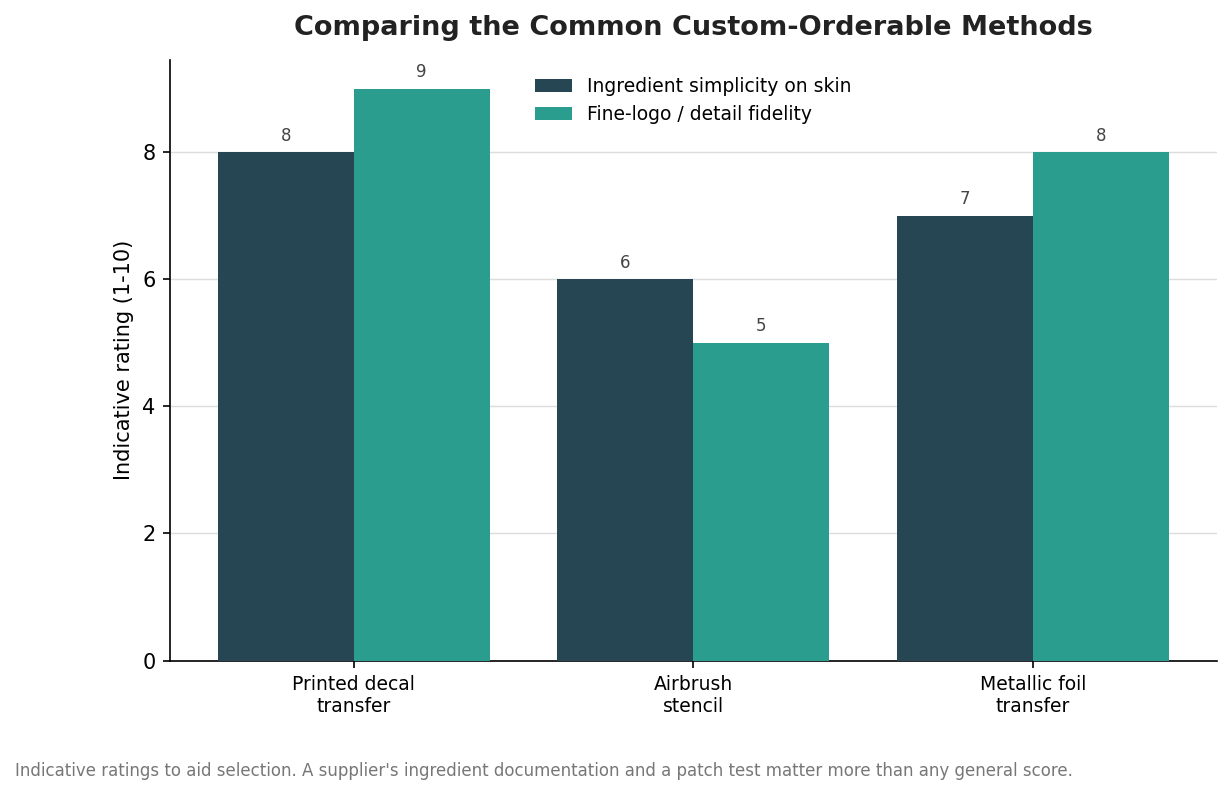
For a branded run where a recognizable logo has to look sharp, the printed decal transfer usually wins on both counts, which is why it dominates the promotional side of the market. The point is not that one method is universally best, but that the safe, effective options are well established and there is no reason to drift toward the risky end of the spectrum for a giveaway.
What to require from a supplier before you order
Put the safety burden where it belongs, on documentation, before money changes hands. Ask any supplier to confirm in writing that the colorants are approved cosmetic color additives for skin contact in your market, that the product is free of PPD and is not “black henna,” and that the adhesive is skin-safe. Request the ingredient list and any compliance or test documentation relevant to where you will distribute, and if the tattoos are aimed at children, ask specifically about the toy-safety standards that apply. A credible manufacturer will have this material ready; hesitation or vague reassurance is itself a useful signal. It is also worth confirming that the products carry appropriate use and warning information, since regulators expect temporary tattoos to be labeled like the cosmetics they are.
A sensible final step
Even with clean paperwork, recommend a patch test, especially for anything going on children or sensitive skin: apply one tattoo to a small area a day ahead and watch for redness or irritation before a whole event’s worth goes on. That single habit catches the rare individual sensitivity that no certificate can predict. Choose a reputable product type, insist on the documentation, keep well away from PPD-based “black henna,” and custom temporary tattoos are a safe, effective way to put your brand on the crowd. Cut corners on the sourcing and you are gambling with someone else’s skin, which is never a trade worth making for a promotional item. When in doubt about the rules for your specific market or use, confirm the current requirements with the relevant authority or a qualified advisor rather than relying on a general guide.