“Temporary tattoo” covers several very different things: a printed sheet you press on with water, an airbrushed stencil, and plant or gel stains like henna and jagua that color the skin itself. They wear for different lengths of time, they set on completely different schedules, and they are not equal on skin safety. Here is how the main types compare, and what the FDA actually says about the ingredients.
Two families: color on the skin versus color in the skin
The cleanest way to sort temporary tattoos is by where the color lives. Printed decals and airbrush tattoos sit a layer of pigment on top of the skin, held by an adhesive or a light body paint. Henna, jagua, and genipin-based semi-permanent inks work the opposite way: they deposit a dye that reacts with the outermost skin cells and stains them, so the design is in the skin rather than on it. That single difference drives almost everything else, including how fast the design appears, how long it lasts, and which safety rules apply.
For a custom, branded design, the printed decal is the workhorse. It reproduces a logo or full-color artwork exactly, goes on in under a minute, and looks identical from the first person to the thousandth. Stain-based methods are prized for a hand-drawn, skin-toned look but are harder to reproduce precisely and take real time per person, which matters when you are decorating a line of guests at an event.
How long each type lasts
Wear time separates the quick decorations from the semi-permanent stains. Airbrush designs typically last about two to five days, and printed decals about three to seven, because both sit on the surface and wear off as the outer skin sheds and rubs against clothing. The stain family lasts noticeably longer: genipin-based semi-permanent inks run roughly one to two weeks, jagua about seven to fifteen days, and natural henna anywhere from one to three weeks, with the deepest, longest-lasting color on thicker skin like the hands and feet. None of these are exact; friction, swimming, soaps, and skincare products all shorten the range.
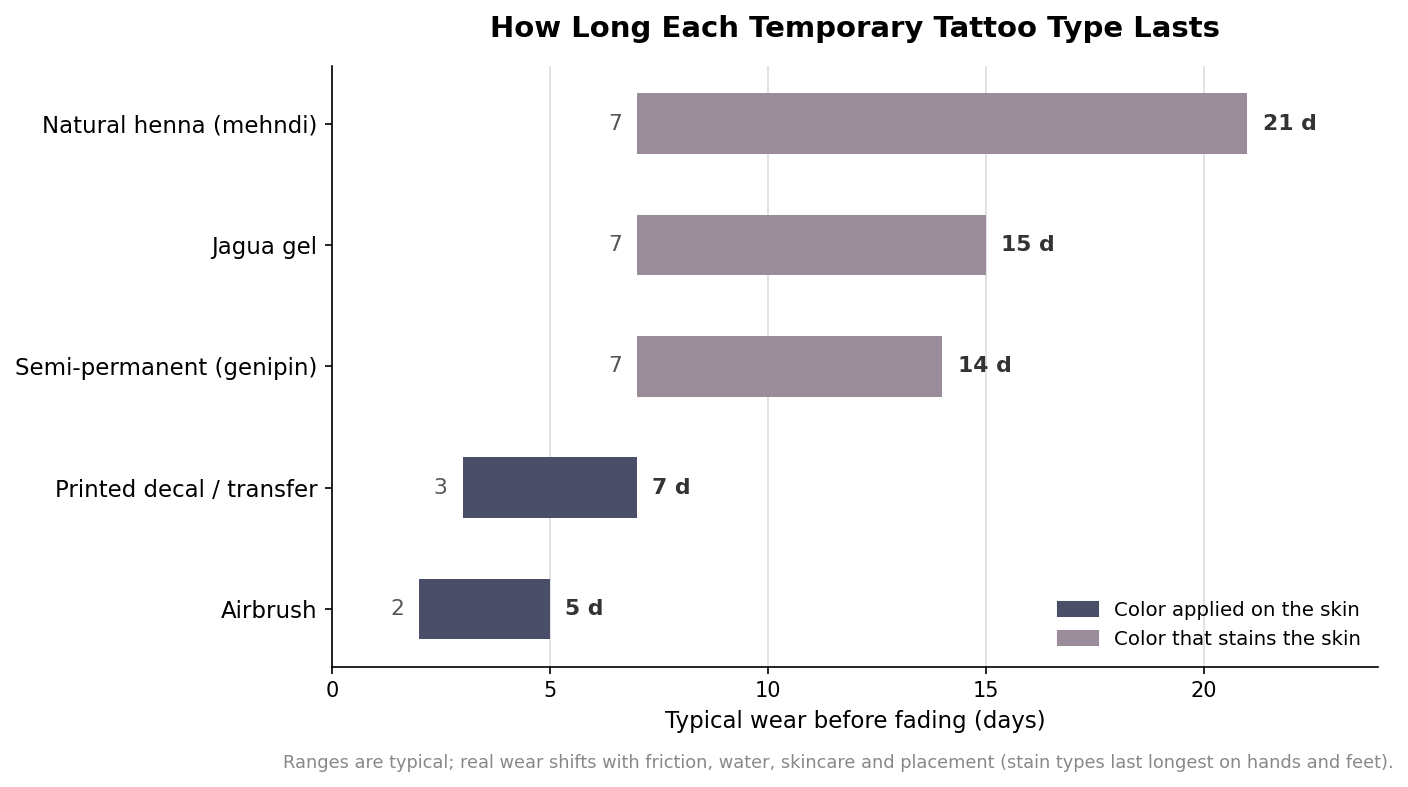
Match the wear window to the occasion. A one-day festival, a race, or a product launch is well served by a decal or airbrush design that fades on its own within a few days. A vacation, a wedding week, or anyone who wants the look to ride out several showers leans toward jagua or henna. If you want a custom logo that reads perfectly and disappears fast, the printed decal is usually the better fit; if you want an organic, evolving stain and can wait for it, the plant and gel options earn their longer wear.
Instant color versus a slow-developing stain
The other schedule that trips people up is set time. Printed decals and airbrush tattoos show their final color the instant they go on, because the pigment is already visible. Stains are the opposite: jagua and henna go on as a paste or gel that looks faint at first and then darkens over roughly 24 to 48 hours as the dye oxidizes, and genipin inks develop on a similar one-to-two-day curve. Jagua in particular needs to stay dry for the first couple of hours and ideally avoids soap for the first day so the stain can mature.
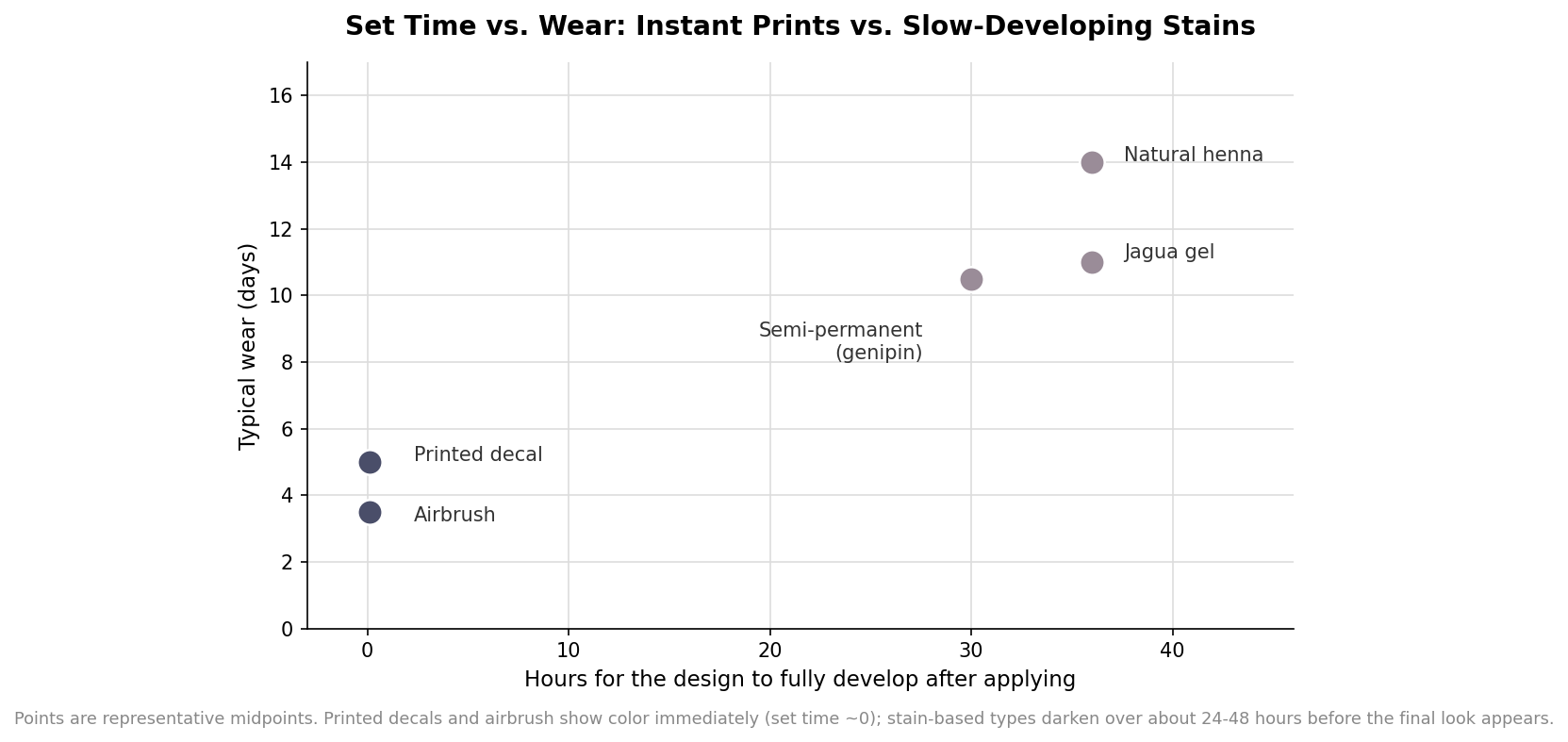
Plan around the develop time, not just the event date. If guests need to look finished the moment they walk away, a slow-developing stain applied on-site will still be pale when they leave; it only reaches full depth a day or two later. That is a strong argument for printed decals at same-day events and a reason to apply henna or jagua well before the moment you want it to peak.
What the FDA actually regulates
In the United States, both decal temporary tattoos and henna are regulated by the FDA as cosmetics, and the agency’s core rule is about color additives. The FDA states that all color additives used in cosmetics must be approved for their intended uses. That framing matters for henna: the FDA says henna “is approved only for use as a hair dye” and “is not approved for direct application to the skin, as in the body-decorating process known as mehndi,” which technically makes skin application an unapproved use. Plenty of natural henna is applied anyway by experienced artists, but the regulatory status is worth knowing.
The real hazard the FDA warns about is “black henna.” To darken henna and speed it up, some products add a coal-tar hair dye containing p-phenylenediamine, or PPD, which the FDA says “can cause dangerous skin reactions in some people.” The agency is blunt that, by law, PPD “is not permitted in cosmetics intended to be applied to the skin,” and it has documented blistering and long-lasting allergic reactions traced to black henna. The practical takeaway is simple: avoid any “black henna” or unusually fast, jet-black stain, and treat a temporary tattoo the way you would a new cosmetic by patch-testing on a small area a day or two ahead if you have sensitive skin. Reputable printed-decal tattoos are made with color additives approved for that cosmetic use and a skin-contact adhesive, which is part of why they are a predictable choice for large branded runs, though you should still confirm a supplier’s compliance and skin-safety information rather than assume it.
Choosing the right type for the job
Work backward from three questions: how exact the design must be, how long you want it, and how much time you have per person. For a logo, a mascot, or full-color artwork that has to look the same on everyone and go on fast, a printed decal wins on precision and speed. For a short, playful, one-day look with a painted finish, airbrush is a good fit. For a hand-drawn, skin-toned aesthetic that lasts a week or more, henna and jagua deliver, provided you build in the develop time and, for henna, accept the regulatory gray area and choose a trusted artist who uses plain, natural paste.
Sort by where the color lives, match the wear window and the set time to your event, and keep the black-henna warning in mind, and the “temporary tattoo” you order will behave the way you expect rather than surprising you a day later.